Is car ownership another pandemic?

Will Sanderson contributes this blog from Shipley and Saltaire Living Streets
Reports of another pandemic are starting to buzz on the news wires. It is more insidious than the one we’ve just lived through, and we’re already losing the race to find a solution. As it travels invisibly through the air causing respiratory disease and excess deaths, people get scared. Tragically, this one also kills kids. Social interactions are curtailed, communities feel the strain, mental health suffers. The poorest are hit hardest, but we all start to feel powerless and disenfranchised. The next pandemic is car-owner virus.

Car dominance, and the entitlement it engenders in drivers, has a lot to answer for: contributing to climate change, polluting the air we breathe, making conversation in the street difficult and unpleasant, isolating the elderly and disabled, disturbing our sleep, contributing to roadside litter, and resulting directly in avoidable injury and deaths.

According to the Council’s own reports, cars are the biggest contributor to air pollution in Bradford, causing 1 in 20 early deaths in the region, and costing local NHS Trusts around £3million per year. Around 200 people are killed or seriously injured on Bradford’s roads every year. And still, millions of pounds are being spent adding capacity to the road network, while too little is done to provide the infrastructure and incentives for alternative modes of transport. This is why 40% of journeys under 2 miles are currently made by car. Now is the time to enable and encourage active travel: a simple lifestyle change that has such enormous health and social benefits.

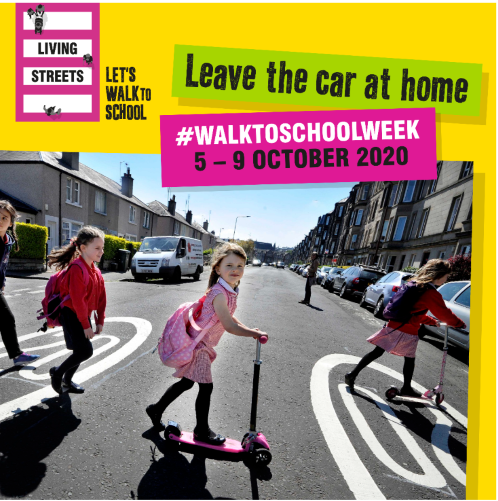
Shipley & Saltaire Living Streets, in support of the excellent campaigning done by the Bradford Shipley Travel Alliance, Clean Air Bradford, and Friends of the Earth, are calling for an end to car-centric thinking in planning and transport (avoid), more joined-up cycling and walking routes (shift), and measures to prevent antisocial driving, parking and rat-running (improve). We need your help! Commit to leaving the car at home whenever possible, or get in touch to join our team. We especially need some help from parents of primary-aged children (to start a walking/cycling bus and play streets), young adults with a flair for social media (to run our accounts), and artistic folk (to do some tactical urbanism).

We have a choice, now, between a cleaner future for people, places and our planet, or continuing with activities which damage our health and environment. Walk with us.
Affiliate spotlight: Veg on the Edge

In the first of our blogs from affilliates, Margot Rowan describes Veg on the Edge

We are a group of volunteers who work together in Saltaire transforming plots of under-used land into community food growing spaces. We meet regularly through the seasons planning, digging, composting, planting, watering, weeding. Once the vegetables, fruit and herbs are ready to eat, everyone is welcome to help themselves and enjoy the produce.

Our plots are well used by people living and working nearby who appreciate access to package-free, fresh, healthy ingredients grown locally in pleasant green surroundings. Just now we have herbs and salad ingredients ready to be picked, lots more in the days to come ….

Members of Veg on the Edge are concerned about the impact of traffic pollution on food production and soil quality near to busy roads. They also know that an appropriate green infrastructure can reduce public exposure to air pollution in the urban environment. They would like these issues to be part of the council’s agenda when planning.

Currently we have 5 growing spaces – The Sunday School Garden in Caroline Street, The Japanese Edible Garden on Exhibition Road, Platform One at Saltaire Railway Station, The Wash House Garden on Caroline Street and The Baker Beds at the far end of Caroline Street.

As well as cultivating our edible crops we are involved in many local events.

You may see us at Saltaire Festival in September.

New members of all ages are very welcome. Gardening expertise is not necessary. 

To find out more about us or join in our activities visit our website: www.vegontheedge.org 

Taking a deep breath: June 10th 7:30pm

Professor Rosie McEachan of the Bradford Institute for Health Research, will be speaking about Air quality, health and Born in Bradford’s plans to evaluate the Bradford Clean Air Plan. It will be a chance to ask questions and join discussion, and all are welcome. Rosie is an applied health researcher, and director of the Born in Bradford study which follows the lives of over 50,000 Bradford residents to explore why some families stay healthy and why others fall ill.

Register for the meeting here: https://www.eventbrite.co.uk/e/taking-a-deep-breath-tickets-152426051423. The meeting will be on Zoom.

Please advertise widely and come to this discussion which will be supported by other clean air scientists, and the campaigning group Clean Air Bradford. Organised by the Bradford-Shipley Travel Alliance, concerned about health and climate impact of traffic schemes between Bradford and Shipley.

https://www.eventbrite.co.uk/e/taking-a-deep-breath-tickets-152426051423

Is anyone there? Just what are the scheme’s aims…

No-one has been willing to state the aims of this Bradford-Shipley road scheme. Our last newsletter pointed out the contradiction between its original justification – to increase traffic as a means of stimulating economic growth – and the current aims of West Yorkshire Combined Authority (WYCA) to reduce traffic to avert climate catastrophe. Each scheme document states a different set of aims.

As promised, we wrote to Bradford Council on 8th March to ask for the scheme’s Benefits Realisation Plan, which all WYCA schemes must have. This would lay out the scheme aims, and how they will be ensured.

Not receiving an acknowledgement or a reply during March, we approached the Councillor responsible for the scheme, Alex Ross-Shaw, who followed it up and assured us that a response would be forthcoming “in due course”.

As of 24th April, there still is no reply.

We also asked for the assumptions being made for scenarios of future traffic. The scenarios, or forecasts, will be core evidence to judge the scheme’s impact on our health. We would like to engage with the Council in a helpful collaborative manner to get the best scheme possible.

No answer to that one, either.

We will knock on the door again in every way we can think of, you can be sure.

CERPs – an acronym to remember

There are many welcome promises to take climate change seriously, and to achieve carbon neutrality by 2030 in Leeds and many other Councils, or by 2038 in Bradford, West Yorkshire and many others, or by 2050 for the UK government.

But rare are the plans that work backwards from a target like those, to lay out just what needs to be done to reach it in the time available.

All credit to West Yorkshire Combined Authority (WYCA) for their report last July, Carbon Emission Reductions Pathways, or CERPs for short.

It explored three pathways, none of which would reach the net zero carbon target of 2038 entirely. Each would leave between 18% and 27% of further reductions that required “a combination of specific, ambitious measures and innovative new technologies as they become available”.

The minimum requirements of the least ambitious pathway include a 21% reduction in car miles travelled. The most ambitious pathway reckons on a 37% reduction in car miles travelled. Both also assume a hefty shift to electric-powered vehicles. All the pathways say that a shift from car to walking, cycling, bus and train is necessary. Necessary to avert what Bradford Council called ‘the enormous harm’ associated with global warming by 2 degrees centigrade, in its declaration of a climate emergency in 2019.

All the pathways demand retrofitting 700,000 houses with insulation, shifting to renewable energy sources, restoring peatland, planting 420 football pitches of trees, and reducing food waste by over one third.

The July 2020 report expected public consultation by December 2020, and WYCA urged further work on measuring carbon emissions. It is nearly a year later and there has not been further public information. But the work is ongoing and shows the scale of change necessary to avert human catastrophe in Bradford as elsewhere.

The CERPs report is essential guidance to all that is coming.